

From Insight to Impact: Inside LOC 6362 with Dr. Stefan W. Vaughn
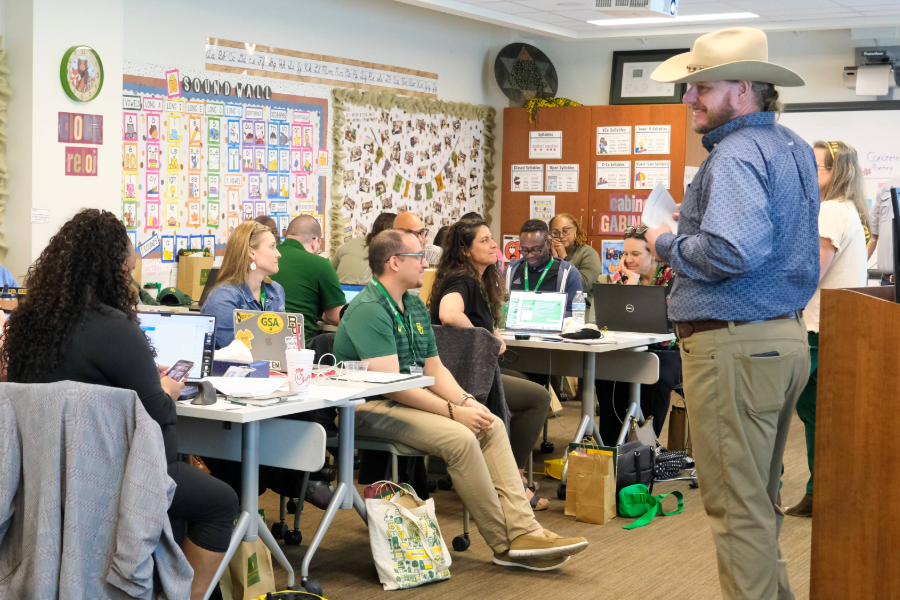
Dr. Stefan Vaughn talking to a group of EdD in Learning and Organizational Change students at Immersion in April 2026.
In many doctoral programs, the “real world” is something you re-enter after graduation. For students in Baylor’s EdD in Learning and Organizational Change (EdD-LOC) program, student’s communities serve as their primary classroom.

Nowhere is this more evident than in LOC 6326: Community Leadership and Collaboration. We sat down with lead instructor Dr. Stefan Vaughn to discuss how the course is moving away from hypothetical models and towards immediate, local impact by equipping scholar-practitioners with the tools and experience to drive real-world impact.
“Doing the Work” in Real Time
The course was recently redesigned to challenge a common academic pitfall: staying in the “planning” phase too long. “At its core, the goal of the course is to have students truly engage in their community,” Dr. Vaughn explains. “They identify gaps, unmet needs, and opportunities—and then build collaborations to address them.”
Unlike traditional conceptions of doctoral coursework, LOC 6362 is deeply project-based and action-oriented. Students don’t simply design hypothetical solutions—they actively step into leadership roles within real organizations, nonprofits, and community groups.
“This is real practical application in real time,” Vaughn says. “They’re not just creating a model—they’re going out, doing the work, building relationships, and delivering results.”
Walking Through the Full Leadership Process
One of the distinctive strengths of the course is its end-to-end approach to community engagement and leadership. Rather than focusing on a single stage of leadership, students are guided through a complete workflow that mirrors professional consulting:
Identifying True Community Needs
Many students begin the semester with a realization: they don’t yet fully understand the gaps in their own backyards. The course pushes them to move past assumptions. “The course compels them to really get out and look,” Dr. Vaughn notes, as they work to pinpoint unmet needs and opportunities for growth.
Engaging Stakeholders and Decision-Makers
Leadership doesn’t happen in a vacuum, so students conduct deep-dive interviews with key local leaders. By exploring existing priorities and resource challenges, these conversations often spark collaborative possibilities that didn’t exist at the start of the
Building Sustainable Collaboration Networks
Bridging the gap between diverse groups requires more than just a good idea—it requires a specific set of communication skills. The course places a heavy focus on developing the vocabulary and relational strategies needed to build and sustain these partnerships over time.
Designing and Implementing the Project
The transition from theory to practice happens quickly. Students move from early concept models to active execution, often beginning the actual implementation within the first few weeks. This “Bias toward action” ensures they aren’t just designing hypothetical solutions, but delivering real results.
From early concept models to active execution, students move quickly from ideas to action—often beginning implementation at the very start of the course.
Establishing Benchmarks for Success
In the final stage, students develop short-, medium-, and long-term goals including key performance indicators (KPSs) to evaluate their effectiveness. However, this stage also introduces one of the courses most complex intellectual challenges: learning how to measure outcomes that are not so easily quantified.
“How do you measure something like prevention?” Vaughn asks. “How do you measure fires that never happened? We work through those kinds of questions to define what success really looks like.”
Where the Dissertation Meets the “Real World”
The EdD-LOC program is specifically built for working professionals, meaning the coursework isn’t a distraction from their careers but an accelerant. LOC 6362 aligns directly with the students Problem of Practice Dissertation, the core doctoral research where students tackle the actual challenges facing their specific industries or communities.
“About half the students directly connect their course projects to their dissertation work,” Vaughn shares. “And many who don’t say afterward they wish they had.”
The immediate application is a defining feature of the Baylor EdD-LOC online experience. Rather than waiting for a graduation ceremony to begin making a difference, they are begin building moment the moment the term starts. As Vaughn explains, ”You’re starting from the beginning. You’re building momentum throughout the course—and many of these projects continue long after the class ends.”
From Pediatric Care to Local Literacy: A Breadth of Impact
The initiatives coming out of the program reflect the diverse professional backgrounds of Baylor’s scholar-practitioners. More than theoretical exercises or academic exercises, these sustained, high-stake efforts provide insights to complex organizational and social challenges.
“These aren’t small exercises. They’re meaningful, sustained efforts that make a real difference.” – Dr. Stefan Vaughn, EdD-LOC Lecturer and Faculty Advisor
The scope of these student-led projects demonstrates the program’s reach into nearly every sector of the community life. In the healthcare space, scholar-practitioners have developed international pediatric surgical networks and preventative care initiatives for women. Within educational and civic spheres, students have launched veteran-student support systems, literacy programs, and STEM collaborations with Native American communities. Other projects have focused on immediate local needs, ranging from mental health crisis support to data-driven initiatives for local animal shelter to help with overcrowding.
A Different Kind of Classroom
The tangible impact of LOC 6362 is driven largely by the shift in how the course is delivered. Following a recent redesign, the curriculum moves away from passive listening toward active engagement and communication. This isn’t just about learning theory, but mastering the “soft skills” required to lead a community through complex change.
To build these competencies, the course utilizes video-based discussions designed to help students refine concise, professional messaging. This carries over into the interactive live sessions, where the traditional power dynamic of a classroom is flipped. Rather than a standard lecture, these sessions are built entirely around dialogue and application of course concepts in the students’ own professional and community contexts.
“In our live sessions, the students are doing most of the talking,” Vaughn says. “We introduce concepts, then immediately apply them to what’s happening in their personal and professional worlds.”
Leading Change That Lasts
Ultimately, LOC 6362 embodies the broader mission of Baylor’s EdD-LOC program: preparing leaders who can translate academic knowledge into immediate, tangible action. For many students, the course serves as a professional turning point where theory meets the pavement and abstract ideas become sustained community initiatives.
“It pushes people out of their comfort zone,” Vaughn reflects. “But that’s where growth happens—and where real change begins.”
Continue the Conversation
The impact of LOC 6362 is a single chapter in the broader story of Baylor’s scholar-practitioners. For those interested in how our curriculum supports working professionals, you can explore our full course sequence or meet the faculty members who will guide your dissertation process. If you’re ready to discuss how a Problem of Practice can address the challenges in your own community, our graduate enrollment team is available to help you navigate your next steps.